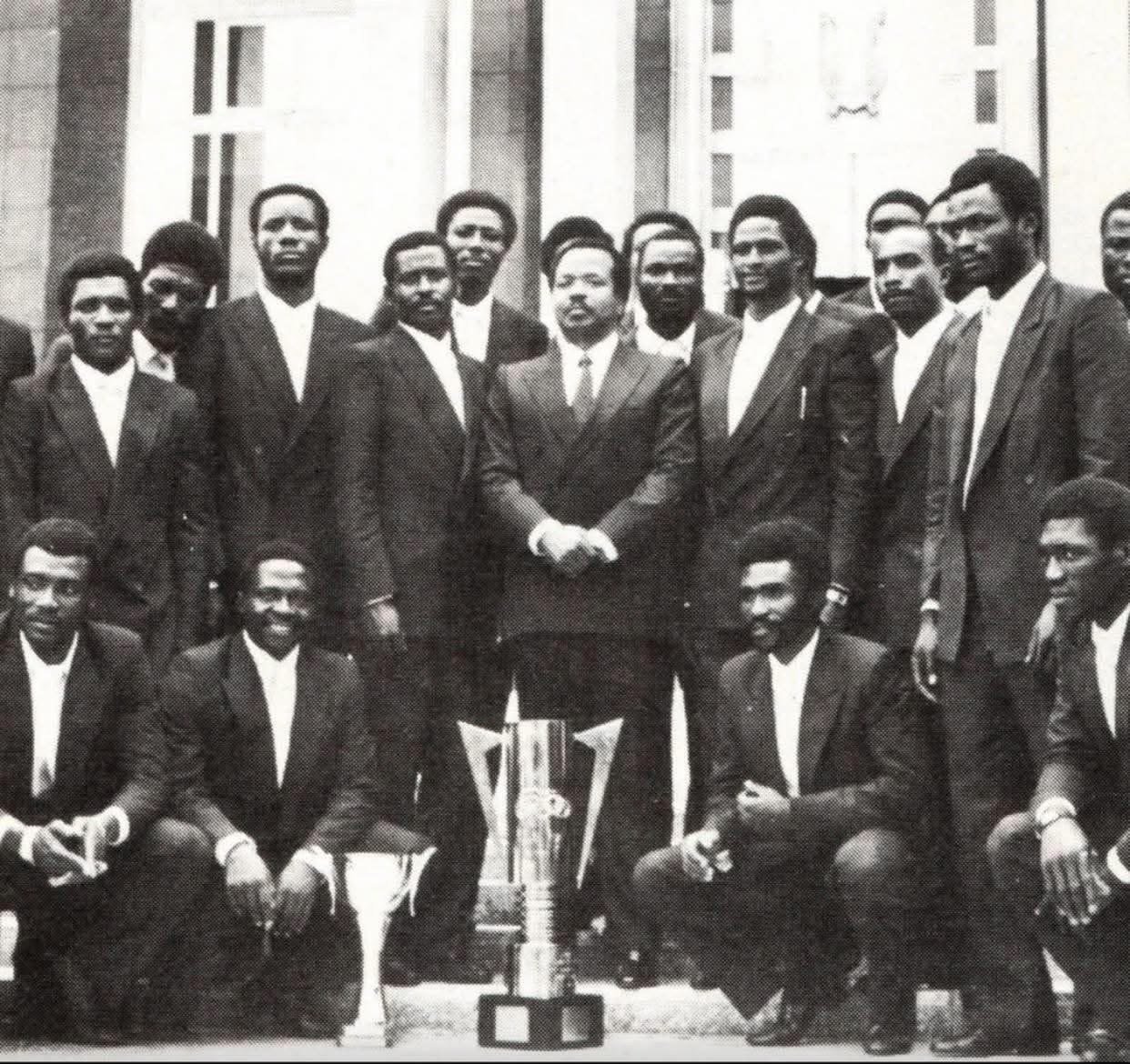
By Angu Lesley
Football Writer,kick442.com-Cameroon
Cameroon’s relationship with the Africa Cup of Nations is one built on history, pride, resilience and an extraordinary capacity to rise when the continent’s biggest football stage demands it. From their first appearance in Sudan in 1970 to five continental titles, the Indomitable Lions have become one of African football’s most decorated national teams. As the continent prepares for the 2027 edition in Kenya, Tanzania and Uganda, Cameroon will arrive carrying the weight of that history and the ambition of a new generation hoping to add another chapter.
The story began in Sudan in 1970, when Cameroon made their first appearance at the Africa Cup of Nations. The team was led by Raymond Fobété, a Cameroonian coach who became the first local tactician to guide the national team to the continental finals. Cameroon announced themselves with a 3-2 victory over Côte d’Ivoire in their opening match and also defeated Ethiopia. However, despite recording two victories, the Lions failed to progress beyond the group stage because of goal difference. It was an early lesson that would become part of the country’s long journey towards continental recognition.
Fobété’s place in that history deserves particular recognition. He was a pioneer who took a young Cameroonian team onto the continental stage, travelling north-east to Sudan at a time when the country’s football structures were still developing. His achievement established an important precedent: Cameroonian football could be led by its own people, not only through the players representing the national colours but also through the coaches entrusted with shaping the team. His story also gives the 2027 journey a special historical dimension. Fifty-seven years after Fobété led Cameroon to their first AFCON finals in Sudan, the Lions will return to the eastern side of the continent for a tournament hosted by Kenya, Tanzania and Uganda.
Cameroon hosted the competition in 1972, reaching the semi-finals before losing 1-0 to Congo. They recovered to defeat Zaire 5-2 in the third-place match, giving supporters an early glimpse of the team’s potential. The country would wait another 12 years before celebrating its first continental crown.
That breakthrough arrived in 1984 in Côte d’Ivoire. Under Yugoslav coach Radivoje Ognjanovic, Cameroon defeated Nigeria 3-1 in the final to lift their first AFCON trophy. Nigeria had taken the lead through Muda Lawal, but René Ndjeya restored parity before Théophile Abega and Ernest Lottin Ebongué completed the comeback.
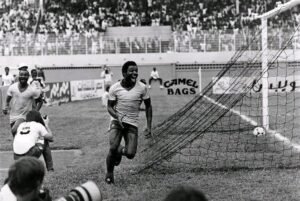
Ernest Ebongue celebrates goal for Cameroon in the final of AFCON 1984
It was a defining triumph for a generation that included Roger Milla, Joseph-Antoine Bell, Emmanuel Kundé, Grégoire Mbida and Isaac Sinkot. Cameroon had moved from promising outsiders to African champions.
CAMEROON WON THEIR FIRST AFCON IN 1984
Cameroon’s 1984 AFCON win was spectacular! They came back from a goal down to beat Nigeria 3-1 in the final, with goals from René N’Djeya, Théophile Abega, and Ernest Ebongué. This victory marked Cameroon’s first-ever AFCON title, and it was a testament to their resilience and determination
The match was played in Abidjan, Ivory Coast, and despite losing Thomas Nkono, their star goalkeeper, due to injury, Cameroon didn’t falter. Théophile Abega was named the tournament’s best player, and his performance was instrumental in securing the win
This victory wasn’t just a moment of glory for Cameroon; it marked the beginning of their dominance in African football, paving the way for future successes, including their quarterfinal run at the 1990 World Cup
Credit: PAJU.TV
Four years later, the Lions proved that the first title was no accident. At the 1988 tournament in Morocco, Cameroon again faced Nigeria in the final. This time, Emmanuel Kundé’s penalty secured a 1-0 victory and a second continental crown. The team, coached by Claude Le Roy, demonstrated the discipline and competitive maturity that would become central to Cameroon’s football identity.
The turn of the millennium brought another golden era. At the 2000 AFCON, co-hosted by Ghana and Nigeria, Cameroon defeated the hosts in a dramatic final that ended 2-2 after extra time. The Lions prevailed 4-3 on penalties, with Samuel Eto’o and Patrick Mboma among the scorers during normal time. The squad featured established names such as Rigobert Song, Lauren, Geremi, Marc-Vivien Foé and goalkeeper Alioum Boukar.
Two years later, in Mali, Cameroon retained the title by defeating Senegal on penalties after a goalless final. Under German coach Winfried Schäfer, the Lions became champions for a fourth time and completed a remarkable back-to-back achievement.

Cameroon🇨🇲 2002 AFCON winners🏆
Kalla, Wome, Alioum, Lauren, Foe;
Eto’o, M’Boma, Olembe, Tchato, Geremi, Song.
The fifth crown arrived in Gabon in 2017, ending a 15-year wait for another continental triumph. Cameroon entered the tournament without being widely considered favourites, but Hugo Broos built a disciplined and united team that grew in confidence with every match. In the final against Egypt, Mohamed Elneny gave the Pharaohs the lead before Nicolas Nkoulou headed Cameroon level from a Benjamin Moukandjo cross. Vincent Aboubakar then produced the decisive moment in the 88th minute, controlling the ball under pressure from Ali Gabr before finishing past veteran goalkeeper Essam El Hadary.

Benjamin Moukandjo leads Cameroon to a fifth continental crown in 2017
The 2-1 victory delivered Cameroon’s fifth AFCON title and reinforced the country’s reputation for producing teams capable of defying expectations.
Cameroon returned to the continental podium as hosts of the 2021 Africa Cup of Nations, played in January and February 2022. The Lions finished third after losing their semi-final to Egypt on penalties and defeating Burkina Faso in the third-place match, also through a penalty shootout. Vincent Aboubakar was one of the tournament’s outstanding performers, scoring eight goals to win the Golden Boot.
FIFA president Gianni Infantino shake hands as
Cameroon’s Vincent Aboubakar becomes the third player in history to score 8+ goals at a single AFCON tournament:
🇿🇲 Ndaye Mulamba (9, 1974)
🇨🇮 Laurent Pokou (8, 1970)
🇨🇲 Vincent Aboubakar
That tally equalled Laurent Pokou’s eight goals in the 1970 tournament, although Pierre Ndaye Mulamba’s nine goals for Zaire in 1974 remain the benchmark for a single AFCON edition.
Aboubakar’s achievement added another chapter to a long tradition of Cameroonian goalscoring excellence. Samuel Eto’o remains the all-time leading scorer in AFCON history with 18 goals, while Patrick Mboma scored 11. Rigobert Song, meanwhile, is among the players with the most tournament appearances, having featured in eight editions, a record he shares with Egypt’s Ahmed Hassan. These figures underline the consistency with which Cameroon have supplied some of the competition’s most influential players.
https://www.facebook.com/share/v/1KK3hkBxSC/?mibextid=wwXIfr
From Fobété to Pagou: The five Cameroonian coaches who have led the Lions at AFCON
Beyond the players and the trophies, Cameroon’s AFCON history has another interesting dimension: the contribution of home-grown coaches. The list of Cameroonians who have taken charge of the senior national team at the continental finals is relatively short, but it spans more than five decades and reflects different generations of the country’s football development.
Raymond Fobété opened the chapter in 1970, taking Cameroon to their maiden AFCON appearance in Sudan. Jules-Frédéric Nyongha followed in 1996, when the Lions competed in South Africa. Two years later, Jean Manga Onguéné led the team at the 1998 tournament in Burkina Faso. Former captain Rigobert Song became the next Cameroonian to take charge at the finals in Côte d’Ivoire in 2023, before David Pagou joined the group at the 2025 edition in Morocco.
The five names are significant because they represent different eras of Cameroonian football. Fobété was the pioneer, Nyongha and Manga Onguéné carried the responsibility during the transition towards the modern era, Song moved from being one of the country’s greatest captains to leading the team from the touchline, while Pagou brought another locally developed coaching voice to the continental stage.

David Pagou dishing out tactical directives at AFCON 2025 in Morocco
Pagou’s appointment ahead of the 2025 tournament was particularly important. After Cameroon parted ways with Belgian coach Marc Brys, the former domestic league tactician was entrusted with the responsibility of leading the Lions in Morocco. His appointment continued a tradition that began with Fobété in 1970 and demonstrated that Cameroonian coaches remain part of the country’s ambitions at the highest level.
The connection between Fobété and Pagou gives the 2027 journey an additional historical layer. One took Cameroon to its first AFCON finals in Sudan; the other led a new generation into the 2025 tournament. As the Lions prepare for another journey towards the eastern side of Africa, the story of these two home-grown coaches offers a reminder that the national team’s history is not only about the players who have worn the shirt, but also the Cameroonians who have carried the responsibility of leading them.
A national story written by different communities
Cameroon’s football history cannot be told through trophies and famous goals alone. It is also a story of communities, towns, regions and generations whose contributions have combined to shape the identity of the Indomitable Lions. From the North-West and South-West to the Littoral, Centre, West, East, Adamawa and the northern regions, the national team has drawn talent from across the country.
The Bali community in the North-West has a place in this history through Raymond Fobété, whose leadership helped take Cameroon to their first AFCON finals in 1970. His story is a reminder that the country’s football development was not built only by the celebrated players who later lifted trophies, but also by the coaches and administrators who laid the foundations.
The Manyu Division, with Mamfe as its headquarters, also has a connection to the history of the national team through two distinguished former internationals: Tataw Eta Stephen and Victor N’Dip Akem. Both are associated with family roots in Mamfe and the wider Manyu area. Tataw became one of the most recognisable captains in African football, leading Cameroon at the 1990 and 1994 FIFA World Cups. He was a central figure in the generation that made history in Italy in 1990, when Cameroon became the first African nation to reach the World Cup quarter-finals. He also won the 1988 AFCON title and later became the first African player to sign for a professional club in Japan.

Son of Manyu Division in the Lions Den over the years
Victor N’Dip Akem was another important member of that era. A defender who represented Cameroon at the 1990 and 1994 World Cups, he also featured in several Africa Cup of Nations tournaments. His career, which included spells with Canon Yaoundé and Olympic Mvolyé, reflects the contribution of South-West football to the national team. Their stories give Manyu a place in the wider narrative of Cameroon’s football heritage.
The Littoral region, particularly Douala and its surrounding communities, has produced and nurtured generations of football talent. Samuel Eto’o’s story is closely linked to New Bell in Douala, where he grew up and began developing the qualities that would eventually make him one of Africa’s greatest footballers. His Bassa-Mpôo-Bati roots are part of the broader cultural diversity represented in the national team. Eto’o’s journey from local football to European success and four AFCON tournaments remains one of the most remarkable individual stories in Cameroonian sport.
The Centre region has also been central to the Lions’ development, with Yaoundé serving as a major football hub and the home of historic clubs such as Canon Sportif and Tonnerre Kalara Club. It is a region associated with generations of national-team players, including Théophile Abega and many of the footballers who helped Cameroon establish itself among Africa’s elite.
The West has contributed through its football schools, clubs and communities, while the North and Far North have remained important sources of talent. Vincent Aboubakar’s football development in Garoua, particularly through Coton Sport, illustrates how the northern regions have helped shape the national team. Although born in Yaoundé, Aboubakar grew into a top-level player through the football environment in Garoua before building a career across Europe, the Middle East and Turkey. His eight-goal performance at the 2021 AFCON gave the northern football community another reason to celebrate.
These examples are not intended to assign footballing achievement to one community or another. They illustrate a national reality: Cameroon’s strength has often come from bringing together players with different backgrounds, experiences and footballing journeys under one flag. The Indomitable Lions are at their best when that diversity becomes a source of unity.
The East African connection and the road to 2027
The 2027 Africa Cup of Nations will take the tournament to Kenya, Tanzania and Uganda, providing Cameroon with another opportunity to compete in a region that has featured in important chapters of its football story. In 2019, Cameroon won the U-17 Africa Cup of Nations in Tanzania, defeating Guinea on penalties after a goalless final in Dar es Salaam. That success demonstrated the country’s continuing ability to produce promising young players and compete for honours beyond the senior level.
There are also individual connections. Defender Che Malone Fondoh built an important part of his career with Tanzanian giants Simba SC, where he became a recognised figure before moving to Algeria. His experience in East African football provides another link between Cameroon and one of the countries that will stage the 2027 tournament.
The region also has a wider historical connection to the story of Central and East Africa. Research into the expansion of Bantu-speaking populations traces important ancestral and linguistic links to the Cameroon-Nigeria borderlands, with subsequent movements reaching parts of Central, Eastern and Southern Africa. This is a complex history spanning centuries, and it should not be reduced to a claim that modern East African communities all originate from Cameroon. Nevertheless, it offers an interesting historical backdrop to a football journey that will take the Lions back to the eastern part of the continent.
Cameroon will also be conscious of the disappointment of missing the expanded African Nations Championship staged in Kenya, Tanzania and Uganda in 2025 after its postponement from 2024. The absence deprived the country of an opportunity to showcase its locally based talent on a stage that was particularly relevant to the region. The 2027 AFCON therefore offers a chance to make a stronger impression in East Africa.
Ten years since the last crown: can the new generation deliver?
Cameroon will enter the 2027 tournament with a question that has followed the team since their 2017 triumph: can the next generation bring home a sixth continental title? A decade will have passed since Aboubakar’s late winner in Libreville, and the country has experienced both encouraging moments and difficult transitions in its search for another successful team.
The current generation has important ingredients. Bryan Mbeumo has established himself at the highest level of European football, while Carlos Baleba has attracted attention for his energy, athleticism and midfield quality. André-Frank Zambo Anguissa remains an experienced presence, and younger attacking talents such as Karl Etta Eyong and Christian Kofane represent part of the country’s future. Their individual quality will matter, but the bigger challenge will be building a balanced team with a clear identity, strong leadership and the collective commitment that defined the 2017 champions.
The 2017 team is an important reminder that a successful AFCON campaign is not always built around the largest collection of stars. It requires organisation, belief, tactical discipline and players who understand their responsibilities. Cameroon have won titles with different generations and different footballing philosophies, but the common thread has always been the ability to perform when the pressure is highest.
With five AFCON titles, Cameroon remain one of the competition’s most successful nations, behind only Egypt in the all-time honours list. Their history stretches from the early pioneers of 1970 to the champions of 1984, 1988, 2000, 2002 and 2017. It includes iconic names such as Roger Milla, Théophile Abega, Emmanuel Kundé, Rigobert Song, Samuel Eto’o, Patrick Mboma, Marc-Vivien Foé, Lauren, Geremi, Nicolas Nkoulou and Vincent Aboubakar.
From Raymond Fobété’s pioneering journey to Sudan in 1970, through the generations led by Jules-Frédéric Nyongha, Jean Manga Onguéné and Rigobert Song, to David Pagou’s appointment in 2025, Cameroonians have continued to play a role in shaping the national team’s destiny from the touchline. The return to the eastern side of the continent in 2027 will offer another opportunity to write a new chapter.
Cameroon are not travelling to Kenya, Tanzania and Uganda simply to celebrate their past. They will be expected to compete, to restore the country’s position among the continent’s leading teams and to pursue a sixth star. Five crowns have already been won by generations of heroes. The next generation now has the opportunity to make history of its own.

 French
 English