By Angu Lesley
Football Writer,kick442.com-Cameroon
The immediate conversation after Argentina’s 3-0 victory over Benin has understandably centred on Lionel Messi, the Argentine Football Association’s commercial gains, ticket sales, the packed Monumental and the many small details surrounding the historic farewell. There has also been discussion around the experience of the Beninese delegation, including questions about security, access and the inability of players to exchange jerseys with their Argentine counterparts. But there is another way to look at this historic encounter — and from Benin’s perspective, it may actually be the more important one. What did the country gain by becoming the opponent for Lionel Messi’s final match for Argentina?
The first thing to acknowledge is that Argentina had an extraordinarily valuable commercial property in its hands. More than 85,000 people filled the Monumental, and reports from Argentina say tickets sold out in just 90 minutes. Ticket prices ranged from about 90,000 Argentine pesos for the popular sections to 480,000 pesos for some premium seats. That obviously created substantial gross ticket revenue, before the costs of staging the farewell, stadium operations, security, production, entertainment and other expenses are considered. The AFA also had a special commemorative Messi shirt produced for the occasion, with Messi himself describing it as a “shirt for a lifetime”, creating another commercial dimension around the event.
It is therefore understandable that people are asking how much Argentina made from the match. But that question can become too narrow when analysing Benin’s participation. Even if the financial value to Benin from the fixture was only a relatively modest amount — whether tens or hundreds of thousands of dollars after whatever arrangements were made — that amount could ultimately be tiny compared with the value of the international exposure the country received. The match was followed by more than 2.59 million people on free-to-air television in Argentina alone, while more than 85,000 attended inside the stadium. And those figures do not capture the international television, digital, social-media, newspaper, radio and video coverage generated by Messi’s farewell.
The viral claim that Argentina-Benin generated 3.1 billion viewers within ten minutes should still be treated cautiously. There is no credible independent audience measurement that I have found to substantiate that extraordinary figure, so it should not be presented as an established world record. But whether the true global audience was hundreds of millions, more than a billion across platforms and territories, or something else entirely, the central point remains: this was an enormous global media event. Messi’s final international appearance was covered around the world, and every report identifying the match also identified Benin as his final opponent. Reuters described the 3-0 victory over Benin as the conclusion of Messi’s 21-year international career, while AP and other major international outlets similarly placed Benin at the centre of the farewell story.
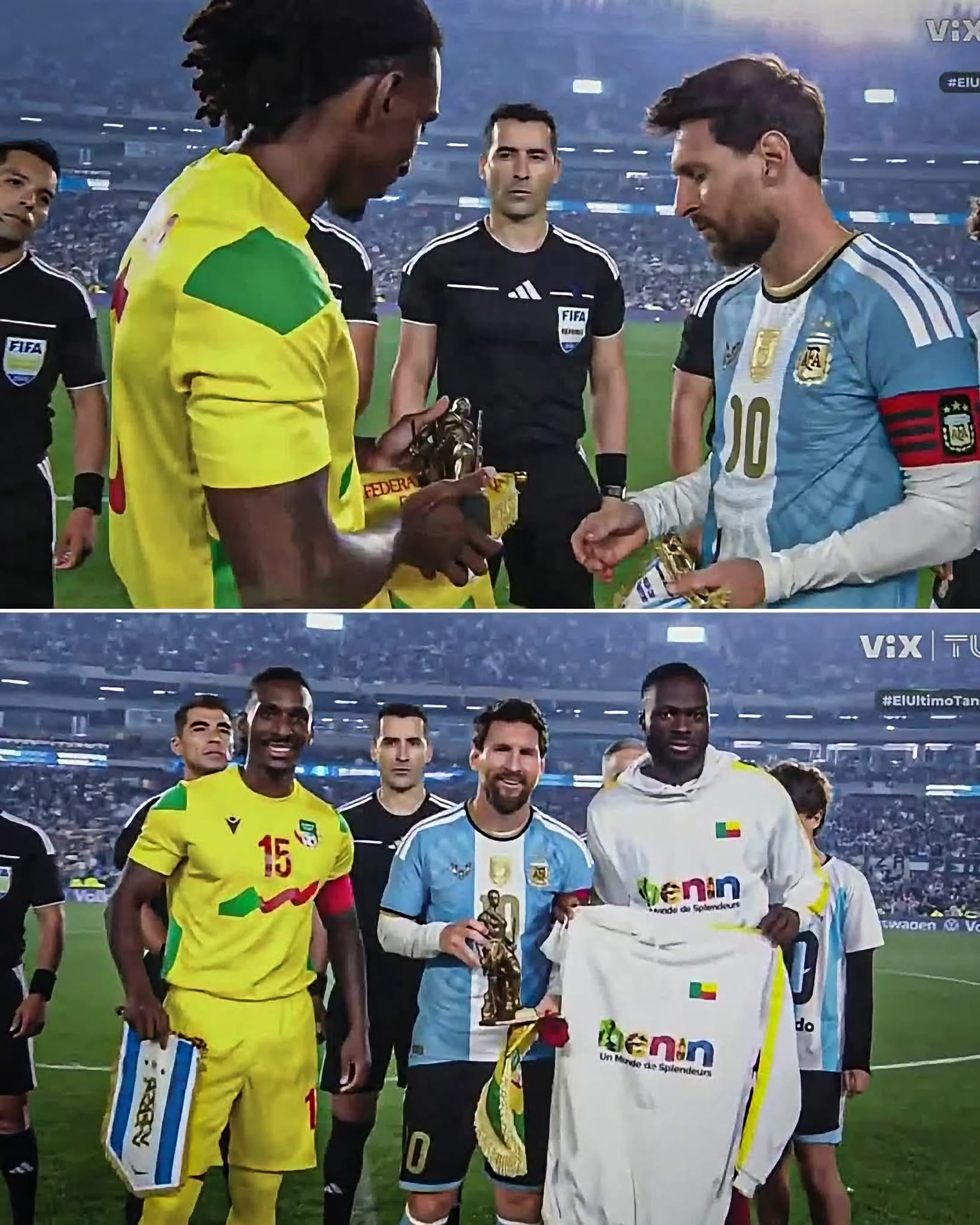
That is where the Benin Football Federation and the country’s officials deserve credit. They got themselves into the room where the world’s attention was going to be concentrated, and they made the most of the opportunity. Before the match, Benin captain Sessi d’Almeida presented Messi with a representation of the Amazone, the famous monument associated with the history and warrior women of the former Dahomey kingdom, together with a letter inviting Messi and his family to discover Benin. That was not simply a football gesture. It was country branding.
The image of Messi receiving an iconic Beninese symbol is potentially more valuable to Benin than another photograph of a player holding a football shirt. It connects one of the most recognisable individuals on Earth with Benin’s history and culture. The Amazone is not an accidental choice either. The monument was inaugurated under President Patrice Talon and has become one of the country’s major cultural landmarks. Benin’s own Amazone platform describes it as a national symbol celebrating the strength, courage and heritage of the women warriors of Danxomè. So when that image travels around the world, it is not merely Messi receiving a gift; it is Beninese history travelling with him.
This is particularly important when considered against the transformation Benin has been pursuing over the past decade. Under Patrice Talon’s administration, tourism, culture, infrastructure and national image-building have received significant attention. Benin’s government says the country has been investing in roads, urban infrastructure, cultural sites, museums, tourism facilities and hospitality infrastructure as part of a wider effort to strengthen the country’s position internationally. A 2026 review by La Nation described the transformation of the tourism landscape over the past decade, pointing to modern infrastructure, rehabilitation of historic sites and the repositioning of cultural heritage at the centre of the national economy.
That work creates an important distinction. You cannot successfully market a destination simply by telling the world that it exists. You need to build something worth visiting — and then tell the world about it. Benin has been doing both. The country has invested in tourism infrastructure and cultural attractions while simultaneously taking its tourism brand to international markets. In 2026, Bénin Tourisme participated in ITB Berlin, one of the world’s major tourism trade events, with the stated objective of strengthening Benin’s international reach, developing the destination and commercialising its tourism offering.
That makes the Messi match a fascinating extension of the same strategy. Instead of paying for a traditional billboard in Buenos Aires saying “Visit Benin”, Benin suddenly had its name attached to Messi’s final Argentina appearance. Instead of buying advertising space beside a tourism photograph, the country had its cultural symbol presented to Messi in front of a packed Monumental and a global audience. And instead of merely telling people about the country, the delegation created a reason for people to search for it.
Imagine someone in Argentina, Europe, Asia or elsewhere who knows Messi intimately but knows almost nothing about Benin. They watch the farewell. They hear the commentator say “Benin.” They see the Beninese players. They see the Amazone presented to Messi. They see photographs of the gesture afterwards. They then search “Benin”, “Amazone Benin”, “Cotonou”, “Ouidah”, “Dahomey” or “visit Benin.” That is how a sporting event becomes a tourism funnel.
And this is why I would be careful about judging the Beninese participation purely by whether the federation made an additional $50,000, $100,000 or even several hundred thousand dollars from the game. A country trying to establish itself as a major African destination could arguably gain more from millions of new people becoming aware of its existence than from a one-off payment. There is no need to pretend that exposure automatically translates into tourism bookings — it does not. But awareness is the first stage of destination marketing, and Benin received an extraordinary amount of it.
The security issue also deserves to be separated from the bigger picture. If Beninese players or officials genuinely felt that their security arrangements were inadequate, that is a legitimate concern and should be investigated rather than dismissed. A visiting national team must be properly protected, particularly when it is participating in an event of unusual global importance. But unless the specific allegations are independently documented, they should remain allegations rather than be presented as established facts. The fact that Argentina’s farewell was historic does not excuse poor organisation if it occurred; equally, unverified complaints should not be allowed to overshadow what was a strategically important opportunity for Benin.
The same applies to the jersey controversy. There has been criticism that Beninese players could not exchange shirts with Argentine players. But there is a very reasonable explanation that needs to be considered. This was not an ordinary friendly. Argentina had prepared a special commemorative shirt specifically for Messi’s farewell, with the entire occasion designed around preserving the memory of the final appearance. Messi himself promoted the shirt with the words “Last match… a shirt for a lifetime.” The shirt was part of the history of the night.
So imagine turning the argument around. If a Beninese player had been told before the match that his shirt would become a historic souvenir because it was the jersey he wore in Lionel Messi’s final-ever international match, would he necessarily want to give it away? Probably not. If somebody walked up to a Beninese player immediately after the game and said, “Give me the shirt you wore in the last match Messi ever played for Argentina,” that jersey would suddenly have enormous sentimental value. The same applies to the Argentine players. Messi’s shirt from that night was never going to be an ordinary football shirt. It was a piece of football history.
That is why something as simple as shirt swapping could easily have been discussed in the pre-match briefing. On a normal international friendly, players regularly exchange jerseys. But this particular game was different. Messi wanted to preserve his final Argentina shirt. Argentina’s other veterans may have wanted to keep theirs. Even younger players may have recognised that they were wearing a commemorative kit for one of the biggest nights in the history of the national team. The absence of shirt exchanges, therefore, should not automatically be interpreted as disrespect towards Benin.
There is also a broader diplomatic lesson here. Benin did not need to be treated like the central attraction of the evening to benefit from the evening. The central attraction was Messi. Argentina was celebrating Messi. The Monumental was celebrating Messi. The Argentine Football Association was celebrating Messi. But Benin had the unusual privilege of being the country on the other side of the pitch when that historic curtain came down.
And that is something the Beninese federation should actually be praised for.
Rather than looking only at what Benin might have received in immediate financial terms, the federation and the government appear to have recognised the value of being part of the occasion and used the platform to promote the country. The invitation to Messi and his family to discover “Un Monde de Splendeurs” was particularly clever because it linked the footballer’s global profile with the tourism brand that Benin is already trying to establish internationally.
This fits neatly into the country’s long-term ambition. Benin’s Vision 2060 – “ALAFIA, un monde de splendeurs” was formally launched in February 2026, reflecting an ambition to position the country on a stronger long-term development trajectory. The tourism strategy is not therefore a reaction to Messi; the Messi opportunity simply landed in the middle of a much bigger national project.
The football federation’s role in that project should not be underestimated. Football is one of the few platforms capable of taking the name of a relatively small country into households across the planet in a matter of seconds. The FBF found itself with a seat at the table on the night the world’s attention was on Messi — and instead of treating the occasion purely as a sporting assignment, the Beninese delegation attached the country’s culture and identity to it.
Argentina may have made money from the tickets. The AFA may have benefited from sponsorship, broadcasting, merchandise and the commercial value surrounding Messi’s farewell. Those are legitimate questions and worth investigating. The players may have wanted to protect their historic shirts. Security arrangements may have had shortcomings that should be examined. And Benin may not have received some of the financial or ceremonial benefits that observers expected.
But none of those things should make us miss the bigger picture.
Benin was given a global stage that would normally cost a government enormous amounts of money to create. For 90 minutes, the name BENIN sat beside LIONEL MESSI and ARGENTINA in one of the biggest sporting stories of the year. Its captain presented one of the country’s most recognisable monuments to Messi. Its government invited the superstar to visit. Its players became the final opponents of an international icon.
For a country that has spent years investing in infrastructure, tourism, culture and its international image, that exposure is not a small thing.
The $100,000 that someone might have negotiated from the fixture eventually disappears. The ticket revenue is counted once. The commercial proceeds are divided and spent. But a photograph of Messi holding a symbol of Benin can circulate for years. A person who discovers Benin because of that photograph can become a tourist. A tourist can become an investor, a business partner or an advocate for the country. And a young football fan who first heard the name Benin because Messi played his final international match against them may remember the country for the rest of his life.
That is the different angle to the Argentina–Benin story. Benin did not win the match. But perhaps Benin did not go to Buenos Aires simply to win a football match. It went into one of the biggest football stages imaginable — and, importantly, it appears to have understood that the real prize was making sure the world remembered who Benin was.

 English
  French