By Oni Ladonette
Journalist,kick442.com-Cameroon
Cameroon has long punched above its weight in world football. This is a nation that gave the world Roger Milla, Thomas N’Kono, Théophile Abega, to name just a few. Players who performed at the very highest level of the game.
Yet back home, where these legends first learned their trade, the domestic league remains mired in mediocrity. Not for lack of talent, but because of a persistent failure to package and present the product professionally.
On January 24, 2026, the MTN Elite One Championship kicked off its latest season at Bafang Municipal Stadium in the country’s West Region. It marked the fourth campaign under Samuel Eto’o’s leadership as president of the Cameroon Football Federation (FECAFOOT), and the first since his overwhelming re-election in November 2025, when he secured 85 of 87 votes.
For a man who embodies African football excellence, a four-time African Player of the Year and the continent’s all-time leading AFCON scorer, Eto’o’s presidency was expected to usher in a new era for Cameroonian football.
Instead, the opening weekend once again exposed the structural weaknesses that have plagued the league for years. It offered a clear explanation for why sponsors remain hesitant and why Elite One continues to sit outside Africa’s top-tier domestic competitions.
A Homecoming Without the Fanfare
The choice of Bafang as the venue for the season opener carried strong symbolism. The town’s club, Unisport du Haut-Nkam, was returning to the top flight after more than seven years away. Local supporters responded in large numbers, queuing throughout the morning to secure tickets for the evening kickoff.
This should have been a celebration of football, but also of Bafang’s culture and the region’s deep-rooted passion for the game.
What followed, however, was a missed opportunity. The pre-match ceremony lasted barely five minutes and featured a generic dance routine set to a medley of Cameroonian songs, with no real reference to the cultural identity of the West Region.
Supporters who travelled from other parts of the country were offered no authentic sense of place, no connection to the community hosting the occasion. It felt functional rather than memorable, football pageantry without imagination.
The halftime show raised even more serious questions. Bad Nova, one of Cameroon’s most popular contemporary artists, performed in front of a crowd of over 3,000. His set included “Hala Madrid”, a song celebrating Real Madrid and its galácticos.
While popular in isolation, its inclusion at a domestic league match was a branding misstep. Instead of reinforcing pride in the local competition, fans were encouraged to celebrate a foreign league. It undermined the very product being sold.
For anyone with a background in sports marketing, the moment was baffling. It was the equivalent of Coca-Cola running a Pepsi advert at its own product launch.
The Devil Is in the Details
If the opening ceremony could be dismissed as an isolated error, events across the rest of matchday one suggested something deeper.
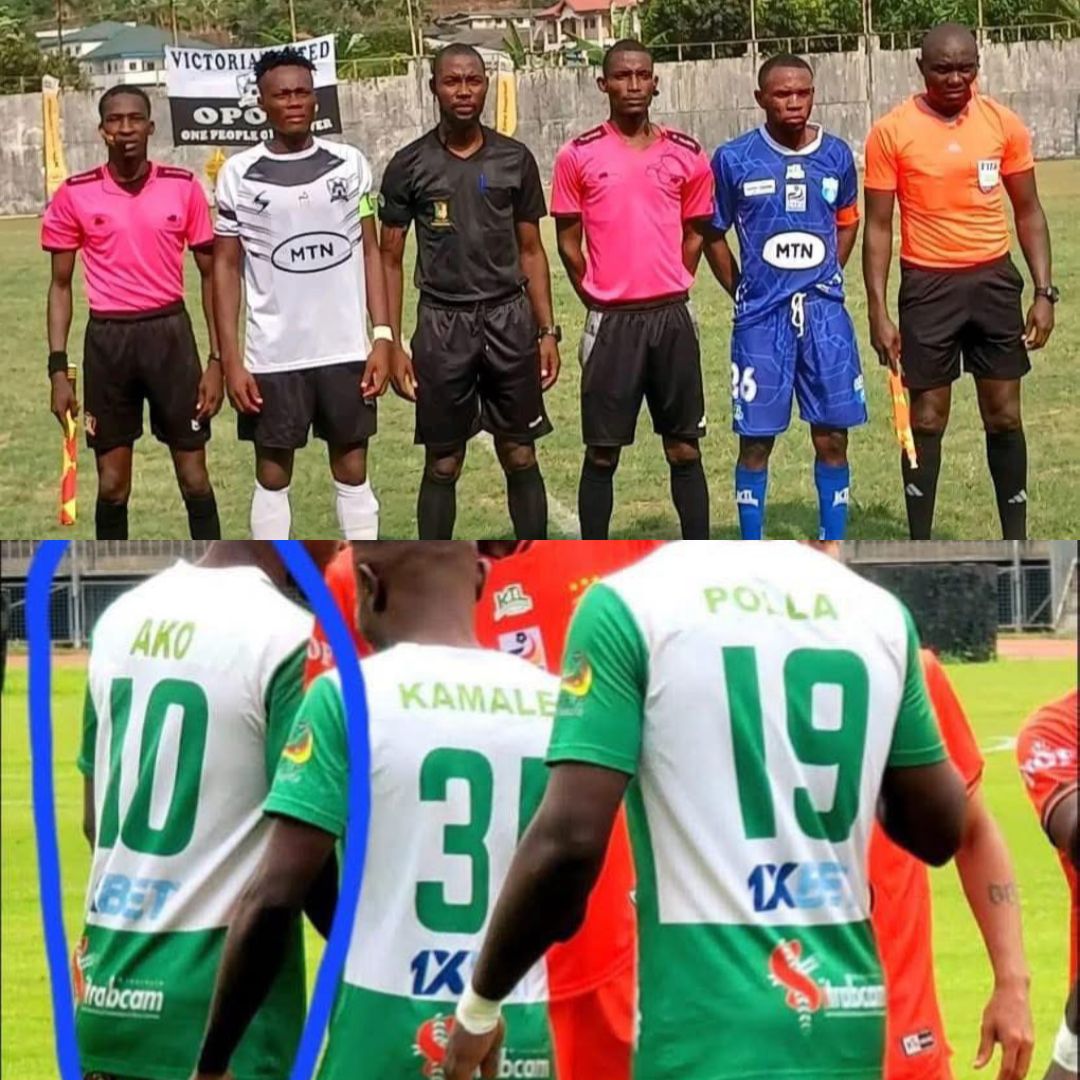
In Yaoundé, during the clash between Canon Sportif and Stade Renard, a Stade Renard player, Ramadan Ngoube was photographed wearing a squad shirt previously assigned to Ako Alexis, who had left the club before the season began. The number had not been reassigned. The shirt was simply reused.
Such administrative lapses are unthinkable in professionally run leagues.
In Limbe, the situation bordered on farce when match officials appeared in mismatched kits. Some wore black, others pink. The lack of uniformity immediately undermined their authority before a ball was kicked.
For a league seeking serious broadcast and commercial partners, such images send a clear message: this is not a competition ready for prime-time exposure.
The arrival of teams at stadiums was equally damaging to the league’s image. Players turned up in mismatched clothing rather than coordinated club gear. Team buses were visibly outdated and poorly maintained, more reminiscent of rural transport than professional football operations.
Individually, these issues may seem minor. Collectively, they reveal a league struggling to meet even the most basic standards of professionalism.
The Talent Exodus Continues
This is particularly tragic given Cameroon’s continued production of elite football talent. The country has long been a football factory, producing technically gifted and physically strong players who thrive in top leagues around the world.
From George Weah, who honed his early skills at Tonnerre Yaoundé despite being Liberian, to Roger Milla’s iconic exploits, the lineage is well established.
According to CIES, Cameroon ranks among the top five exporters of football talent in Africa and around 30th globally. Every year, players leave local clubs and academies for opportunities in Europe, Asia, and the Americas.
Yet this constant export has done little to raise the profile of the domestic league. Unlike Egypt or Morocco, where strong local competitions fuel investment and visibility, Cameroon’s Elite One is viewed by many young players as something to escape from, not build upon.
The Broadcast Blind Spot
Ahead of the season, FECAFOOT announced a broadcast partnership with private channel MSI. On paper, it appeared to be a step forward.
In reality, MSI’s limited transmission capacity has left entire regions unable to watch matches. Several fixtures remain effectively invisible to the national audience.
At a time when even lower-tier European leagues stream matches globally, Cameroon’s top division struggles to achieve consistent national coverage.
This has serious commercial consequences. Sponsors need visibility. When matches are inaccessible, the value of advertising and brand association collapses. It becomes difficult to justify significant investment without guaranteed exposure.
Current sponsors including MTN, Tiof, and 1xBet provide some stability, but these deals alone cannot address the league’s financial problems. Each season brings the same issues: unpaid wages, stadium rental disputes, and repeated appeals for government support.
The underlying problem is clear. Elite One has never been monetized in line with the quality of talent it produces.
Repackaging the Product
Modern football is a business. Broadcasting rights, sponsorship, merchandising, and matchday experience now determine whether leagues survive and grow.
Cameroon has been slow to accept this reality. Administrative competence and commercial strategy are still treated as optional rather than essential.
Other African leagues have shown what is possible. Egypt’s Premier League, Morocco’s Botola, and South Africa’s PSL have invested in presentation, officiating standards, broadcast quality, and sponsor activation. They understand that perception matters as much as results.
For Elite One to follow suit, fundamental changes are required. Clear branding guidelines, consistent visuals, proper matchday protocols, and reliable nationwide broadcasts are essential. Streaming platforms should be used to reach the diaspora and international audiences.
Above all, there must be a shift in mindset. Every detail contributes to how the league is perceived.
Samuel Eto’o’s Challenge
Samuel Eto’o’s re-election was meant to signal stability. His legacy as one of Africa’s greatest footballers gives him unmatched credibility.
However, credibility alone cannot fix decades of structural neglect.The task ahead is difficult but achievable.
Eto’o must convince sponsors that Elite One offers real value. He must enforce professional standards within FECAFOOT and push clubs to modernize their operations. Most importantly, he must help Cameroonians reconnect with their own league.
The foundations exist. Talent continues to emerge. Supporters still show up, as Bafang proved. The footballing history is rich and respected across the continent.
What is missing is professionalism, attention to detail, and commercial vision.
A Call to Action
Cameroon’s domestic football is at a crossroads. It can continue producing stars for foreign leagues while its own competition fades into obscurity. Or it can accept that talent alone is not enough.
The opening weekend of the 2025–2026 season showed little evidence of progress. Mismatched kits, disorganized teams, and halftime entertainment celebrating foreign leagues are not accidents. They are symptoms.
The Indomitable Lions nickname reflects Cameroon’s refusal to be overawed on the global stage. That same spirit must now be applied at home.
Until the Elite One Championship is treated with the seriousness it deserves, it will remain what it is today: rich in talent, poor in presentation, and permanently falling short of its potential.

 English
  French