Kick442 Éditorial Team
Two years ago, South Africa arrived at AFCON 2023 classified as outsiders, having missed the 2021 edition entirely. Fast forward to today: following their run to the bronze medal, Bafana Bafana is now viewed as a genuine title threat. Adding urgency to their campaign, legendary coach Hugo Broos—who has announced his full retirement from coaching next year—is determined to cap his career by delivering the nation’s second-ever AFCON silverware.
Background
South Africa has participated in three FIFA World Cup and will be making their 12th Africa Cup of Nations appearance in Morocco. The 1996 winners have been on the AFCON podium on four occasions.
Team Bio
Plagued with Apartheid, South Africa was banned from participating in the Africa Cup of Nations from 1959 to 1992. They qualified for the 1957 tournament but were later disqualified.
They made their AFCON debut in 1996 as hosts. South Africa was then drawn in Group A with Cameroon, Egypt and Angola. In their first ever AFCON game, against Cameroon, they won in style with a 3-0 score line. Philemon Raul Masinga, Mark Williams and John Moshoeu were the goal scorers for South Africa and Coach Clive Barker’s men had made a huge statement of intent. Mark Williams got his second goal of the tournament in their 1-0 win over Angola in their second game. Their 0-1 loss against Egypt in their third game was inconsequential as they still finished top of the group. In the quarterfinals against Algeria, Mark Fish and John Moshoeu were on target for South Africa, while Tarek Lazizi scored Algeria’s consolatory goal.
They made Ghana look ordinary in the semifinals with a 3-0 bashing. John Moshoeu bagged a brace and Shaun Bartlett opened his goal scoring account in the tournament in front of 75,000 spectators at the FNB Stadium in Johannesburg. In the final against Tunisia, Mark Williams scored both goals in a 2-0 win as South Africa lifted their first AFCON trophy at the first time of asking.
Burkina Faso hosted the 21st edition of the tournament in 1998. Bafana Bafana were determined to hold on to their prized jewel. They were drawn in Group C with Côte d’Ivoire, Angola and Namibia. Draws with Angola(0-0) and Côte d’Ivoire (1–1) were followed by a 4-1 mauling of neighbors Namibia.
Benni McCarthy stole the show with all four goals for South Africa. With five points they booked their place in the knockout stage behind Côte d’Ivoire with seven points. Against Morocco in the quarterfinals, Benni McCarthy continued to shine, he opened the scoring at the 22nd minute for South Africa. Saïd Chiba equalized for Morocco but South Africa got their winner through David Nyathi. Two time winners DR Congo were their opponents at the semifinals. Benni McCarthy was literally walking on water, as he bagged a brace in their 1-2 win and secured them a second consecutive final after extra time. South Africa fell short against Egypt in the final as Ahmed Hassan and Tarek Mostafa’s goals handed Egypt the trophy in Ouagadougou.
In the first ever AFCON cohosted by two countries(Ghana and Nigeria), South Africa were drawn in Group B with Algeria, DR Congo and Gabon. Vincent Dumisa Ngobe and a brace from Shaun Bartlett gave them a 3-1 win over Gabon in their opening game. Bartlett was on target again in their 1-0 win over DR Congo in their second game. He scored his fourth goal of the tournament in their 1-1 draw with Algeria in their final group game. As group B winners, they were drawn against Group A runners-up Ghana in the quarterfinals. Siyabonga Eugene Nomvethe’s 42nd minute goal was all they needed to see off Ghana. In the semifinals against host Nigeria, Tijani Babangida was a handful for them as his brace booked the host a place in the final and Bafana Bafana had to settle for a classification game against Tunisia. Bartlett with his fifth of the tournament and Nomvethe with his second scored for South Africa but Ali Zitouni replied with two goals for Tunisia and the game was decided in a shootout after extra time., South Africa prevailed on a 4-3 score line. For the third consecutive time, they were on the AFCON podium.
The South African decline was steady, in 2002 in Mali, they battled their way out of Group as group winners ahead of Ghana, Morocco and Burkina Faso. Two goalless draws in their first two games against Burkina Faso and Ghana respectively and 3-1 win over Morocco, with goals from Sibusiso Wiseman Zuma, Thabo Mngomeni and Siyabonga Nomvethe saw them finish as Group B table toppers. They did not come to live against hosts Mali in the quarterfinals. Bassala Touré and Dramane Coulibaly scored for Mali in a comfortable 2-0 win.
They were eliminated at the Group stage in the next three tournaments and failed to qualify for the next two.
In 2004 in Tunisia, Siyabonga Nomvethe’s brace against Benin in a 2-0 win was followed by a 4-0 humiliation to against Nigeria and a 1-1 draw with Morocco thanks to a goal from Patrick Mzolisi Mayo. South Africa were eliminated with four points in Group D behind Morocco with seven and Nigeria with six points.
Another dismal performance followed in 2006 in Egypt were they finished 16th out of 16 participating nations. They lost all three games in Group C in what is till this date their worst ever AFCON performance. They lost on an identical 2-0 score line to Guinea and Tunisia before losing 1-0 to Zambia. They bowed out with no point and no goal scored.
In 2008 in Ghana, they were drawn in Group D with Tunisia, Angola and Senegal. They failed to win any of three games, with two draws and one loss. Elrio van Heerden scored a late equalizer in their 1-1 draw with Angola, before a 3-1 loss to Tunisia with Katlego Abel Mphela with their lone goal of the game. Van Heerden again opened the scoring in their final group game against Senegal, but Henri Camara replied for Teranga Lions in a 1–1 draw. For the third consecutive time they were eliminated at the groups stage.
The last and only time South Africa had previously hosted the tournament, they emerged as winners. They had a chance to repeat that feat in 2013. South Africa were drawn in Group A with Morocco, Angola and Cape Verde. A 0-0 draw with Cape Verde in their first game was followed by 2-0 win over Angola. Siyabonga Sangweni and Michael Majoro were on target for the hosts. They settled for a share of the spoils with Morocco in their final group game in a 2-2 draw. Issam El Adoua gave Morocco the lead in a game full of late drama. May Sphiwe Mahlangu equalized for South Africa. Abdelilah Hafidi restored Morocco’s lead at the 82nd minute but South Africa showed great spirit and got their equalizer at the 86th minute through Siyabonga Sangweni with his second in the tournament. Their quarterfinals game against Mali started well, the curtain raiser from Tokelo Rantie. Seydou Keïta scored Mali’s equalizer and the game stretched into extra time and was decided in a shootout. Dean Furman, Mahlangu and Majoro missed their spot kicks and Mali progressed to the last four to the disappointment of the belligerent home supporters.
Another disappointing groups stage exit followed in 2015 in Equatorial Guinea. Drawn in a very difficult Group C, South Africa managed just a draw in three games. Thuso Phala’s goal against Algeria was not enough in a 3-1 loss in their first game. Oupa Matthews Manyisa gave Bafana Bafana the lead against Senegal but Kara Mbodji got an equalizer for the Teranga Lions. Their final group game against Ghana was a must win but they fell short again. Mandla Grateful Masango’s 17th minute goal was cancelled out by goals from John Boye and Andre Ayew. South Africa were eliminated at the groups stage.
In 2017 in Gabon they failed to qualify and returned in 2019 in Egypt for their 10th Africa Cup of Nations appearance. It wasn’t a vintage performance, but they at least managed to reach the knockout stage. A loss to Côte d’Ivoire (1-0) in their first game was followed with a 1-0 win over Namibia thanks to a goal from Bongani Zungu. They lost their last game(1-0) to Morocco but qualified for the knockout stage in the AFCON’s first 24 teams tournament as best losers from Group D. In the round of 16, they were up against host nation, Egypt in front of 75,000 spectators at the Cairo International Stadium. Thembinkosi Lorch silenced the home support with an 85th minute winner. 2013 winners Nigeria were their quarterfinals opponents. Samuel Chimerenka Chukwueze opened the scoring for Nigeria at the 27th minute before Bongani Zungu equalized for South Africa at the 71st minute. Nigeria had the final word through an 89th minute from William Paul Troost-Ekong. South Africa’s wait for another AFCON win continues.
With 2017 AFCON winning coach Hugo Broos at the helm of the team, there was a new wave of hope and believe around as they traveled to Côte d’Ivoire for an 11th AFCON participation, and plugged home a bronze medal.
The team’s first victory was a decisive statement in the group stage. After an opening loss to Mali, South Africa roared back against Namibia with a comprehensive 4-0 victory. The goals started with a penalty calmly slotted by Percy Tau. The momentum was seized by Sundowns’ Themba Zwane, who delivered a clinical first-half brace, proving his enduring value to the team. Thapelo Maseko completed the rout with a goal in the seventy-fifth minute, securing a vital clean sheet and boosting confidence.
The Round of 16 brought their most defining moment: a clash against tournament favorites and World Cup semi-finalists, Morocco. The Bafana Bafana secured a famous 2-0 victory. Evidence Makgopa provided the breakthrough, finishing from an acute fifty-seventh minute. The win was sealed in dramatic fashion deep in added time when midfielder Teboho Mokoena stepped up to curl a sublime free-kick into the net, sending the country into raptures.
Their quarter-final against Cape Verde proved to be a goalless battle of attrition, taking the game all the way to a penalty shootout. With no goals scored in open play, the pressure mounted, but captain Ronwen Williams emerged as the undeniable hero. He delivered a historic performance, saving four penalties to guide South Africa to victory and book a spot in the semi-finals.
Heartbreak followed in the semi-final against Nigeria, a match that also concluded in a 1-1 draw before an agonizing loss in the penalty shootout. South Africa went a goal down late, but in the final moments of regular time, a crucial VAR intervention awarded them a penalty. Teboho Mokoena displayed nerves of steel to convert the spot-kick, forcing extra time and ensuring the contest was not settled easily.
Their final fixture was the Third Place Play-off against DR Congo, another tense, goalless affair that inevitably led to another penalty shootout. Proving his earlier heroics were no fluke, Ronwen Williams again saved the decisive penalty, securing a 6-5 shootout victory and clinching the well-deserved AFCON Bronze Medal.
The 2025 journey
Following their inspiring run to the bronze medal at the 2023 AFCON, South Africa carried that momentum directly into the qualification campaign for the 2025 tournament in Morocco. Under coach Hugo Broos, Bafana Bafana showcased a new level of consistency and attacking flair, successfully navigating Group K to secure their place at the finals with an impressive, unbeaten record.
South Africa was drawn into Group K alongside three competitive neighbours: Uganda, Congo, and South Sudan.
Matchday 1: South Africa 2-2 Uganda
6 September 2024
18:00 UTC+2
South Africa 2–2 Uganda
Foster 14′
Mbatha 90+5’//Omedi 51′
Mato 53′
Orlando Stadium, Johannesburg
10 September 2024
15:00 UTC+2
South Sudan 2–3 South Africa
Okello 15′ (pen.)
Yuel 57’//
Appollis 17′, 45+2′
Mbatha 90+5′
Juba Stadium, Juba
11 October 2024
20:00 UTC+2
South Africa 5–0 Congo
Mokoena 12′, 27′
Aubaas 37′
Foster 52′
Rayners 78′
Nelson Mandela Bay Stadium, Gqeberha
15 October 2024
17:00 UTC+1
Congo 1–1 South Africa
Bassouamina 45+3’//
Mokwana 33′
Stade Alphonse Massemba-Débat, Brazzaville
15 November 2024
15:00 UTC+3
Uganda 0–2 South Africa
Morena 49′
Maswanganyi 89′
Mandela National Stadium, Kampala
19 November 2024
14:00 UTC+2
South Africa 3–0 South Sudan
Rayners 7′
Maswanganyi 22′
Mokoena 50′ (pen.)
Cape Town Stadium, Cape Town
Players to watch
Themba Zwane
The start of coach Broos’ era as Bafana coach wasn’t so kind for the man they call ‘msishi’. He was sidelined for a long period – but now, Zwane is a key piece for Broos despite just returning from injury. He at times unplayable in South Africa’s run to bronze in Côté D’Ivoire, and as one of the more experienced players in the squad, he will look to leave a mark in Morocco with his ability to combine and find litlle pockets of space in opposition territory.
‘Ronza’ Ronwen Williams
Few moments when keeper’s are tipped as players to watch, which shows how dire Ronwen Williams is to his side.
The Sundowns first choice was voted 2024 as CAF goalkeeper of the year, following his exploits for club and country. The Ex Supersport goalie was equally nominated for the 2024 Yashin Trophy, where he finished 9th. With over 52 appearances to his name, he will be looking to captain his team to glory.
Evidence Makgopa
Born in GaMampa, near Burgersfort in Limpopo, Magokpa is a tested man for the big occasions. He has most often repaid Broos’ trust with big goals, despite not being as prolific with his club side Orlando Pirates. Magokpa has relentless energy and can keep the ball if the team is under pressure. Coupled with some of his crucial goals, he is a player to keep an eye on in Morocco.
Teboho Mokoena
With 3 goals to his credit in the AFCON qualifiers, central midfielder, Teboho Mokoena finished top scorer for South Africa. He is not shy to aim at goal from range and his set piece mastery will really acts as a goal threat. Mokoena has been arguably the most consistent player in this new loook Bafana.
Oswin Appollis
Appollis, 24, has cemented his place in South African team as an undisputed starter. He is one of the young wingers Broos is banking on and just like Mokoena, he has an inch perfect delivery and can find the net when the chances come. Appollis, since his acquisition from Polokwane City has been a mainstay in the Orlando Pirates team, and looks to carry that into the AFCON.
Mohau Nkota
From Orlando Pirates now to the Saudi premier League with Al-Ettifaq, Nkota is a tricky customer when deployed on either flanks. Watch out for his pace, dribbling ability and passing ability in the final third. Nkota is only 21 but wears an old head on young shouldeds.
Khuliso “sailor”Mudau
Khuliso is one of the best fullbacks on the continent, and adds that experience to his team. Difficult to beat one-v-one and with the ability to whip in a perfectly timed cross into the area, Mudau is irreplaceable to his team.
Coach Hugo Broos
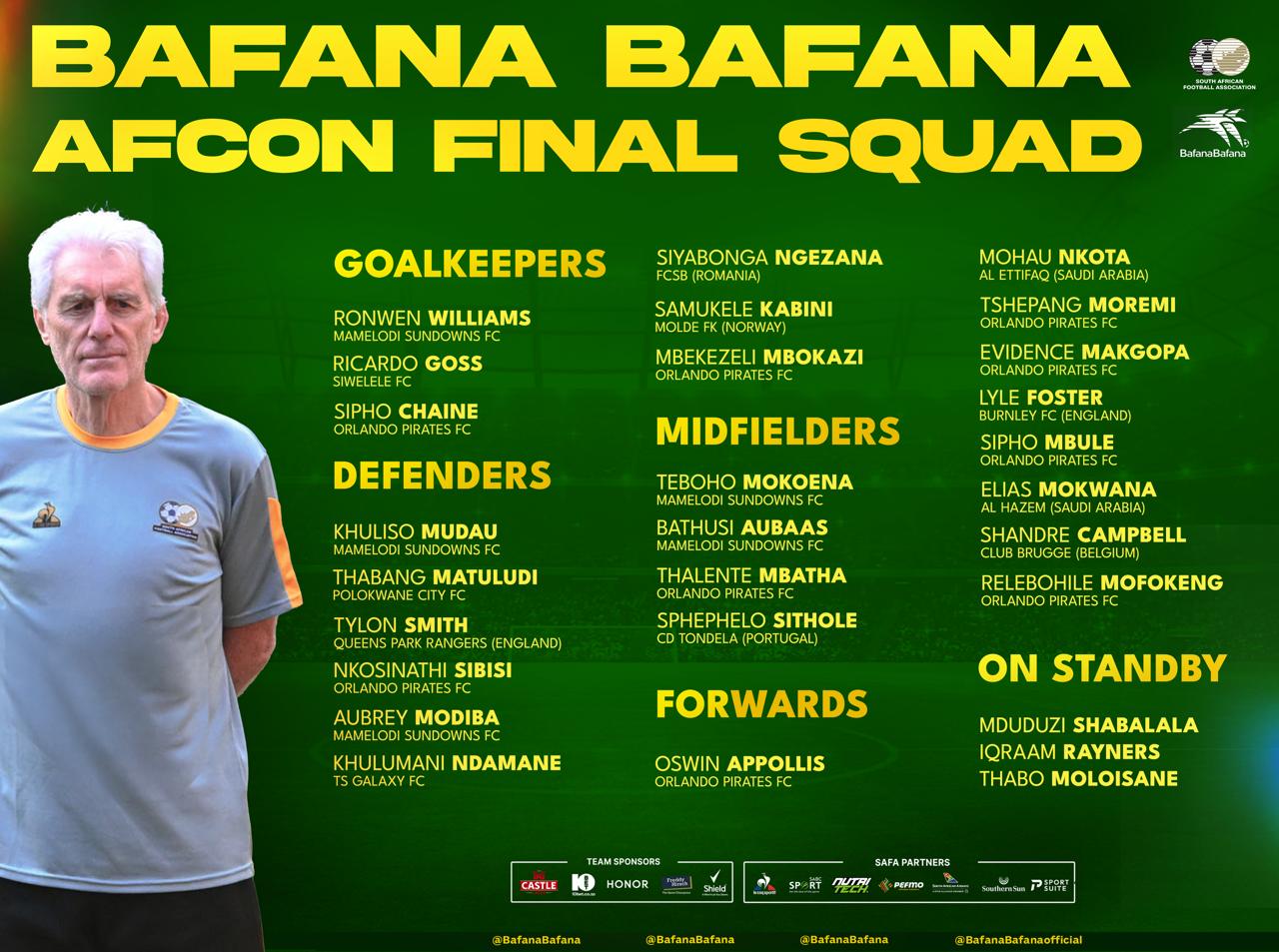
73-year-old Belgian coach Hugo Henri Broos who led Cameroon to 2017 Africa Cup of Nations glory in South Africa will be the man to try and mastermind South Africa’s second AFCON triumph after ending third in Côté d’Ivoire. The former Anderlecht and Club Brugge player won multiple league and Cup titles during his playing days and has also won two league title and two Belgian Cups with Club Brugge as coach. The 1992, 1996, 2004 and 2006 Belgian Professional Coach of the Year is known for his strict discipline and tactical awareness. With Broos in charge, South Africa has a man who can take them to the promise land again, in fact, after having handed them successive AFCON qualifications sandwiched between a 2026 World Cup qualification.
2023 AFCON matches Group E
SA Group Fixtures
Bafana Bafana’s group stage campaign will be confined to two major Moroccan cities: Marrakech and Agadir.
Opening Match (Dec 22): South Africa begins its quest against Angola at 8:30 PM (Local Morocco Time/WAT) in Marrakech.
Dec 26: The highly anticipated showdown is the second match against Egypt at 6:00 PM (Local Time) in Agadir. This fixture is widely seen as the biggest test for the squad in the group.
Group Conclusion Dec 29: South Africa wraps up the group stage with a Southern African derby against Zimbabwe at 8:30 PM (Local Time), returning to Marrakech.

 French
  English