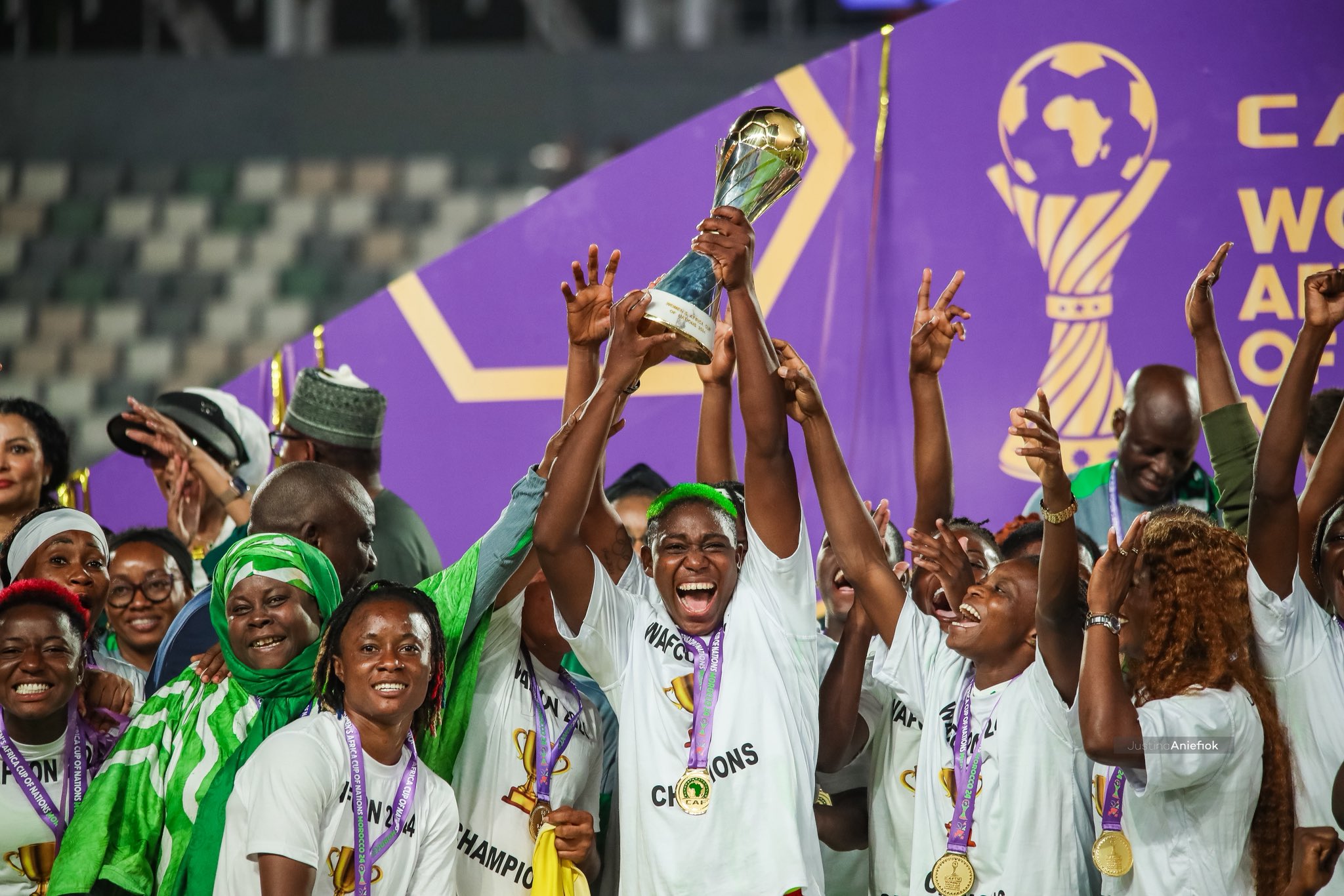
By Awambeng Fuh
Journalist kick442.com – Cameroon
When Asisat Oshoala speaks, African football listens. The Super Falcons striker, one of the continent’s most decorated players, rarely courts controversy. That is why her recent social media post questioning the Confederation of African Football’s (CAF) relationship with Morocco struck a nerve across the football ecosystem.
The big question here is when will this whole CAF compensation to Morocco end,” Oshoala wrote. “Awards, tournaments and all…… it’s getting boring now. We need other countries to step up. Everything concerning African football happens in Morocco, feels like that’s the new HQ.”
Her words echoed a sentiment that has been quietly simmering among fans, administrators, and even players: has CAF become too closely aligned with Morocco?
A Relationship Under the Spotlight
Over the past few years, Morocco has emerged as the undeniable hub of African football. From hosting major tournaments to staging CAF award ceremonies, referee courses, executive meetings, and age-grade championships, the North African nation has become a constant presence on CAF’s calendar.
The country hosted the 2022 Women’s Africa Cup of Nations, the 2023 Club World Cup on behalf of CAF, and has repeatedly been selected for CAF events across men’s and women’s football. Morocco is also set to host the 2025 Africa Cup of Nations, after previous hosts withdrew.
On the surface, the explanation is straightforward: Morocco is prepared.
The country boasts world-class stadiums, efficient logistics, political stability, and heavy state investment in sport. Its football federation, backed by government support, has built infrastructure that meets — and often exceeds — CAF and FIFA standards. In an era where last-minute withdrawals by host nations have become common, Morocco offers certainty.
Yet for many critics, including Oshoala, the issue is no longer about readiness alone.
Perception of Imbalance
African football has long struggled with uneven development. While countries like Morocco, Egypt, and Senegal continue to rise, others feel increasingly marginalised. Critics argue that CAF’s heavy reliance on Morocco risks reinforcing this imbalance.
For them, the problem is not Morocco’s ambition, but CAF’s apparent lack of effort to rotate opportunities across the continent.
Awards ceremonies held repeatedly in one country. Tournaments clustered in one region. Strategic decisions that seem to favour a familiar partner. Over time, these choices have created a perception — fair or not — that Morocco enjoys preferential treatment.
That perception matters,” says one West African football administrator, speaking anonymously. “CAF may have practical reasons, but football is also about inclusion and representation. When everything keeps going to one place, people feel shut out.”
CAF’s Dilemma
CAF’s leadership faces a difficult balancing act. African football has suffered from poor organisation, underfunded hosting, and political interference in the past. When countries fail to meet hosting obligations, CAF is left scrambling.
Morocco, by contrast, rarely fails.
From CAF’s perspective, entrusting major events to a reliable partner reduces risk and enhances the global image of African football. Successful tournaments attract sponsors, broadcasters, and credibility — something CAF has fought hard to regain in recent years.
But critics argue that leadership is not only about choosing the safest option; it is also about developing capacity elsewhere.
If CAF keeps going back to the same country, how will others ever catch up?” asks a former international player. “Experience is part of development.”
The Player’s Voice
Oshoala’s intervention is significant because it represents a player-led critique of governance, something still rare in African football. Her comments tap into a broader frustration among players who feel disconnected from decision-making processes that shape their careers.
Women’s football, in particular, sits at the heart of the debate. Morocco’s investment in the women’s game has been widely praised, but critics warn that excellence in one country should not come at the expense of continental growth.
The fear is that CAF’s dependence on Morocco could inadvertently create a two-tier system — countries with access and influence, and those permanently left behind.
Is Morocco to Blame?
Importantly, many analysts caution against framing the issue as Morocco versus the rest of Africa. Morocco has simply taken advantage of opportunities created by strong planning and investment. Few would fault a country for being prepared when others are not.
The deeper question is whether CAF has done enough to help other nations reach that level.
Investment support, infrastructure grants, transparent hosting criteria, and rotational policies could help spread opportunities more evenly. Without such measures, frustration will continue to boil over — on social media and beyond.
A Warning Sign for CAF
Oshoala’s comments should be seen less as an attack and more as a warning. When elite players begin publicly questioning governance structures, it signals a disconnect between administrators and stakeholders on the pitch.
African football is at a critical moment. Global attention is growing, talent is undeniable, and investment potential is high. But credibility depends on fairness, transparency, and inclusiveness.
CAF must now decide whether convenience will continue to guide its decisions — or whether it will take the harder route of building capacity across all regions.
Because if the perception of an “unholy marriage” continues to grow, the damage may not be to Morocco’s image, but to CAF’s legitimacy itself.

 French
  English