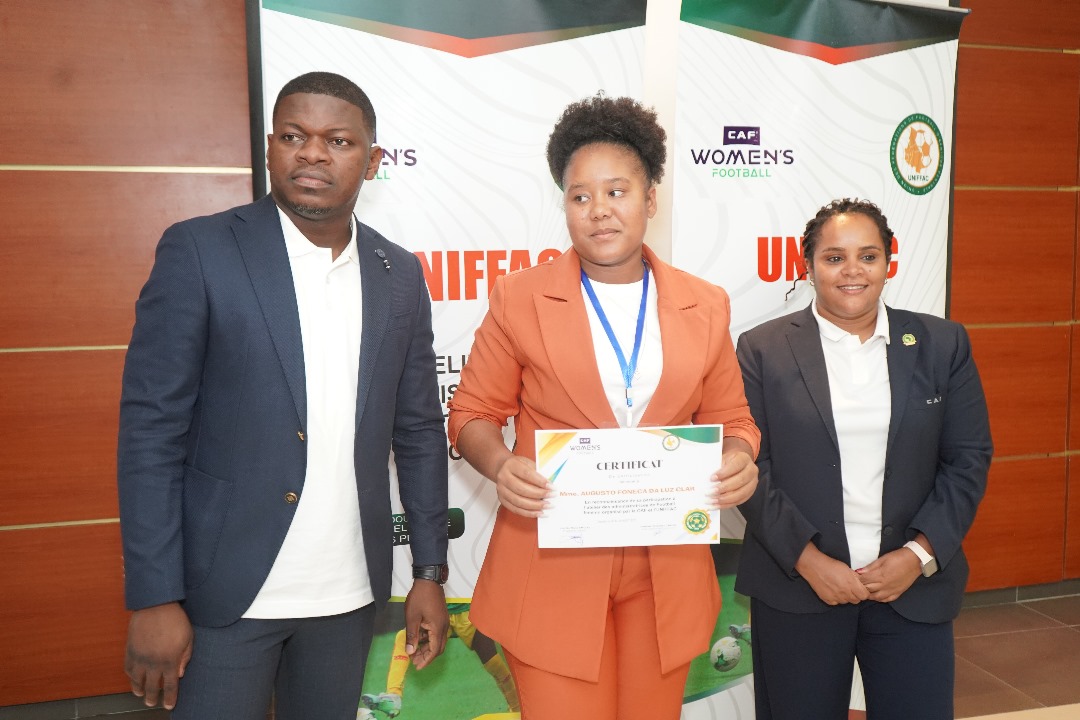
- A two-day CAF-UNIFFAC capacity-building workshop has ended in Douala, bringing together women’s football administrators from across Central Africa
- The sessions focused on marketing, collaboration, and strategy to drive development across the subregion
- Cameroon’s delegation shared insights from its national setup, while CAF and UNIFFAC officials emphasized ownership, connection, and practical follow-up
Women’s football administrators from across Central Africa gathered in Douala for a two-day workshop aimed at boosting management and development efforts across the subregion.
The training, organized by CAF and UNIFFAC, closed on Wednesday, August 8, 2025, with clear calls for stronger collaboration, tailored marketing strategies, and a shared commitment to growth.
Sidonie Tagne, Secretary General of the Cameroon Women’s Football League, was one of the key voices at the event. She highlighted the importance of unity across Central African federations, pointing out that real progress can only happen when countries move together.
“This training is extremely important for us in Central Africa. We must join forces if we want to grow women’s football,” she said.
Tagne emphasized that Cameroon’s experience offers a solid case study for the region.
“Cameroon is seen as a model in Central Africa. We’ve done a lot already, and we need to use that experience to guide others,” she added.
During the workshop, her delegation shared an overview of their national team structure, which includes four women’s squads , the senior Lionesses, the U20s, the U17s, and a U15 team that is nearly ready for competition.
“Our presentation caught many by surprise,” Tagne said. “They didn’t expect us to have four national selections, all active. This kind of structure gives us a strong foundation, but also a responsibility to support others in the region.”
The conversation was not limited to tactics and teams. Administrators were encouraged to take the business side of football seriously, especially in areas like branding and sponsorship.
“Each of us is expected to go back home and develop marketing plans that can bring in sponsors. We also have to come up with strategic development plans and share them with CAF, FIFA, and UNIFFAC,”
Tagne explained.
CAF’s Head of Women’s Football, Meskerem Ghosime, praised the level of engagement and practical focus.
“The quality of the training and the interaction we saw show that the content was worth delivering,” she said. “There was real enthusiasm among participants. That tells us the message landed well.”
Ghosime noted that CAF’s goal is not just to host events, but to support long-term impact.
“This kind of seminar should produce a roadmap for the zone. We want each member association to go back with clear priorities for women’s football in the coming years,” she added.
She also underlined the importance of building ties between countries.
“This is a platform for networking. We want to see more collaboration between federations, whether through friendlies, knowledge exchange, or joint initiatives,” Ghosime said.
Director of finance Uniffac, Remy Nnang Zogo also present, took a similar approach, focusing on grassroots solutions.
“We know the challenges, but change has to come from those working directly in the game,” He explained.
“Top-down pressure won’t solve anything if the member associations are not taking action themselves. What matters is that local administrators identified problems, worked with instructors, and proposed solutions. Now it’s our job to support them in implementing those plans.”
The workshop made it clear that Central Africa is not at a single pace when it comes to women’s football. Some federations are still finding their footing, while others, like Cameroon, are working to deepen their influence in the region.
“Every country has its own level and realities,” Tagne said. “We’re not here to compete with each other off the pitch. We’re here to lift the entire zone.”
The event in Douala was more than a talk shop. It was a strategic huddle to review what’s working, identify what’s missing, and commit to building a stronger women’s football system. With clear assignments in hand and new networks established, the next step is execution back home.
Copyright©2025 kick442.com-Cameroon
All rights reserved. This material and any other digital content on this platform may not be reproduced, published, broadcast, written, or distributed in full or in part, without written permission from our management.
This site is not responsible for the content displayed by external sites

 English
  French